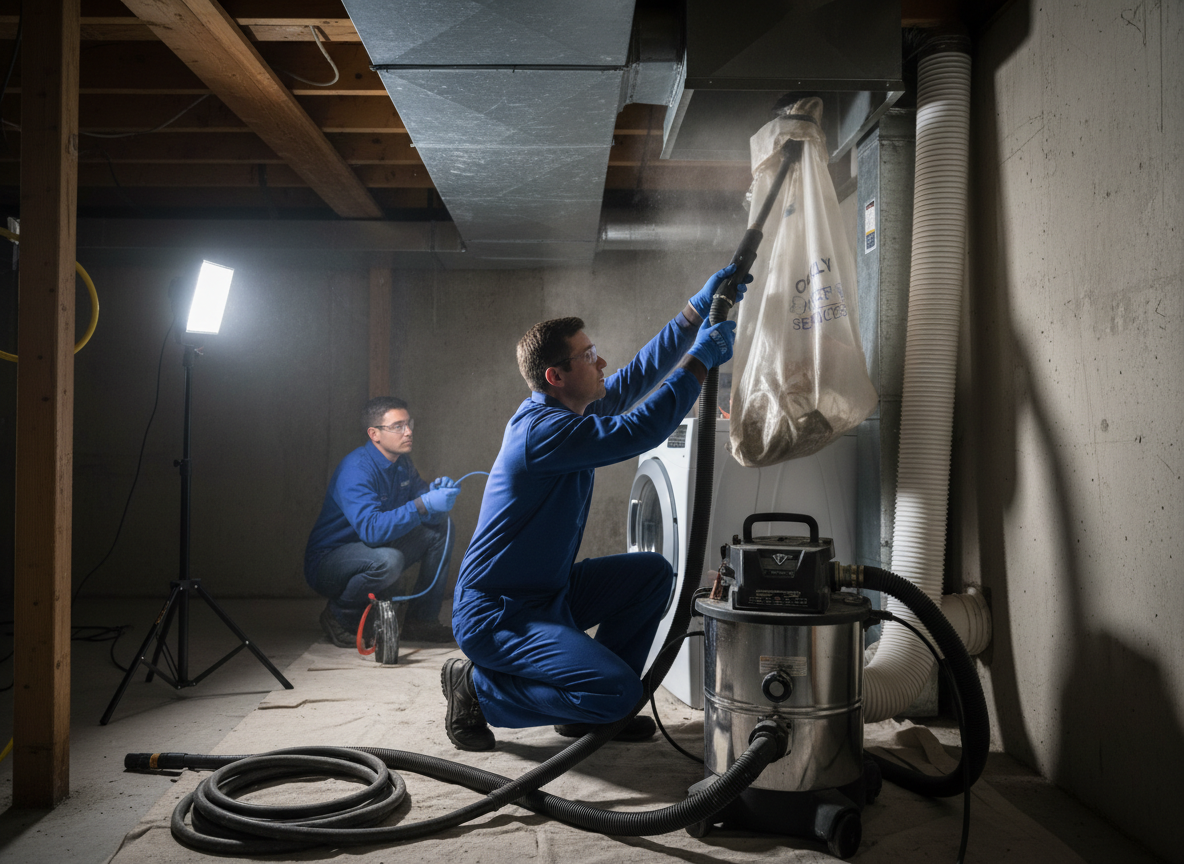
Oakley sits in Hamilton County with many early-1900s brick and frame homes whose original duct runs often include sharp turns and narrow branches that collect fine dust and dryer lint faster than newer construction. Winter heating cycles pull in dry air that carries more particulates through these systems, while summer humidity encourages mold growth on any accumulated debris inside the trunks. Technicians at Orbit Wrench start every job with a camera inspection to map access points before negative-air machines are connected at the main trunk near the furnace.
Dryer vents in these neighborhoods frequently terminate in cramped crawl spaces or behind finished basement walls, creating hidden lint traps that reduce airflow and raise fire risk. When vents run more than twenty feet with multiple elbows, standard brushes cannot reach every section, so the crew uses rotary whips and compressed air to dislodge material before vacuum extraction. Homeowners are shown the removed debris on-site so they can see exactly what was restricting the line.
Access challenges appear regularly in Oakley because many homes have finished ceilings or exterior siding that covers the vent termination. Crews protect flooring and furniture with drop cloths and seal registers during cleaning to keep dust contained. After the main ducts and dryer line are cleared, each register is vacuumed individually and the system is balanced to restore even airflow throughout the house.
Because Oakley borders neighborhoods like Hyde Park and Norwood, crews often work on similar vintage homes where shared wall construction can route ducts through difficult-to-reach cavities. The 24/7 availability from the Williams Avenue base allows same-day response when a dryer vent becomes completely blocked during heavy laundry days in winter.
Technician insight
In Oakley, the thing that catches most people out with air duct and dryer vent cleaning is the narrow, multi-elbow runs in 1920s and 1930s homes that trap dryer lint right where the line passes through finished basement ceilings; those spots need rotary whips instead of straight brushes or the blockage stays put.
Blocked dryer vent in Oakley two-story
Homeowner reported the dryer taking two cycles to finish clothes. Camera showed a lint plug where the vent turned behind the basement ceiling. Crew opened one access point, used rotary agitation to break the plug, extracted the material, and restored full airflow without opening finished walls.
How it works
- 1
Initial Camera Inspection
Technicians scope every accessible trunk and branch to identify blockages, mold, or damaged sections before any equipment is connected.
- 2
Register and Vent Sealing
Registers are removed, openings are sealed with magnetic covers, and the dryer vent is disconnected at both ends to isolate the system.
- 3
Negative-Air and Agitation Cleaning
A high-volume vacuum is attached at the furnace or main trunk while rotary brushes and compressed air dislodge debris along the full length of ducts and the dryer line.
- 4
Final Extraction and Reassembly
All loosened material is extracted, registers are reinstalled, the dryer vent is reconnected, and a post-clean camera check confirms clear passages.
Pricing
Upfront quotes after on-site inspection; final price depends on duct length, number of turns, and access difficulty.