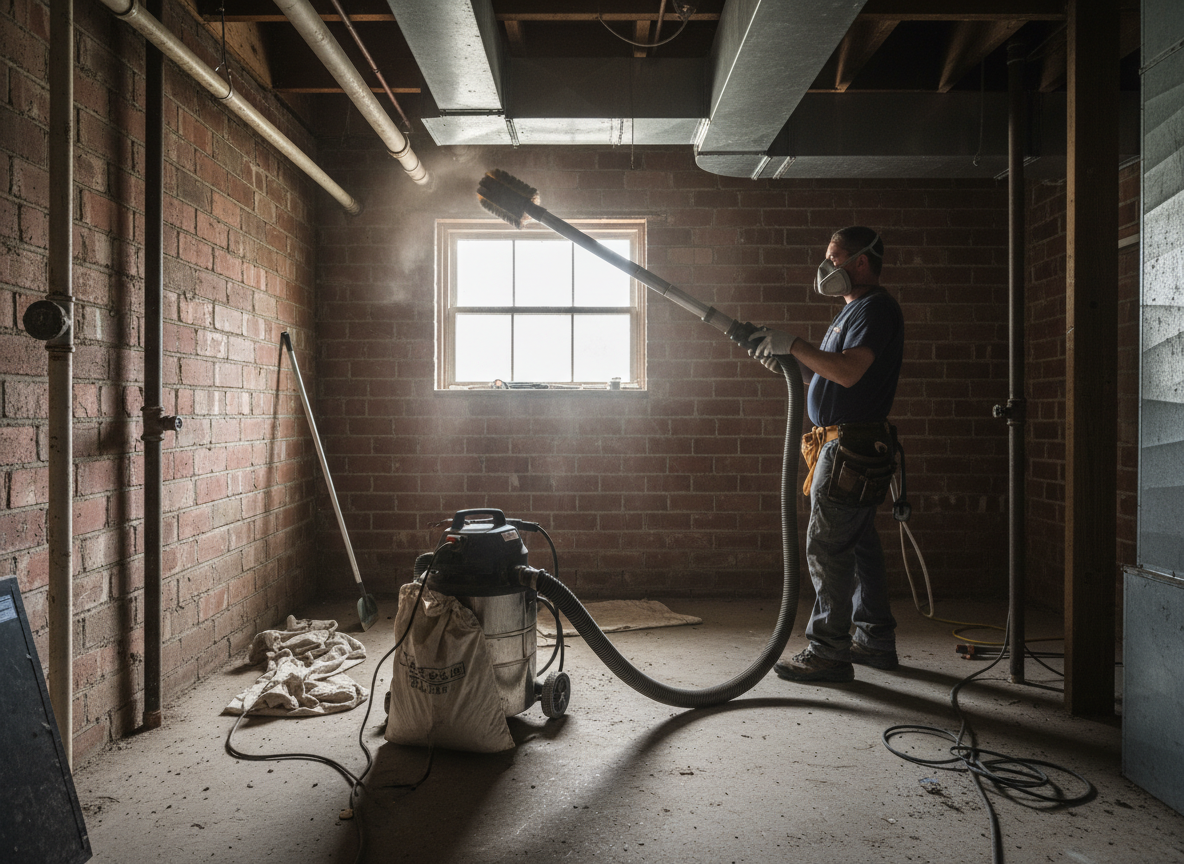
Oakley homes, many built between the 1920s and 1960s with brick exteriors and finished basements, often have long horizontal trunk lines that collect construction dust, pet dander, and insulation fibers over decades. When these lines run through unconditioned spaces above crawl spaces or along exterior walls, temperature swings in Cincinnati winters push more debris into the airstream. Cleaning requires removing registers, sealing the system, and using negative-air machines sized for the actual static pressure of older ductwork rather than generic shop-vac setups.
Access points in Oakley are frequently limited to small hand holes cut decades ago or none at all in finished ceilings. Technicians must work around plaster-and-lath construction and knob-and-tube wiring remnants that remain in some blocks east of Madison Road. Forcing equipment through undersized openings risks damaging the ducts or disturbing settled material that then migrates to living areas. Proper technique includes mapping the run first with a camera, then working from the farthest branch back to the furnace to keep debris moving toward the vacuum.
After heavy heating seasons, return-side ducts in these homes commonly show higher accumulation near floor registers because cold air infiltration pulls outdoor particles inward. Supply runs that travel through exterior walls can develop condensation points where insulation has settled, leading to localized mold spots that require targeted agitation rather than whole-system fogging. Every job ends with a visual check of the plenum and a test of static pressure to confirm no new restrictions were introduced during cleaning.
Seasonal Considerations
Winter heating cycles in Oakley move the most volume through ducts; scheduling after the first cold snap but before deep freeze allows crews to work without frozen condensate issues in exterior lines.
Technician insight
In Oakley the thing that catches most people out with HVAC duct cleaning is the older brick homes where the main trunk sits behind finished basement ceilings with almost no access panels, so you end up cutting new openings and then patching around 1920s plaster that cracks if you look at it wrong.
Oakley Bungalow Return Line
Homeowner noticed dust on furniture shortly after furnace startup. Camera showed heavy buildup in the return trunk running along the east foundation wall. Crew cut one new access point, extracted the material under negative pressure, and restored airflow without disturbing the finished ceiling above.
How it works
- 1
Initial Camera Inspection
Technician runs a camera through main trunks and branches from the Oakley address to identify blockages and access points.
- 2
Register and Vent Removal
All accessible registers are taken off and the system is sealed at returns and supplies to create negative pressure.
- 3
Agitation and Vacuum Extraction
Whips and brushes loosen debris while the negative-air machine pulls material out through the main trunk.
- 4
Final Camera Verification
Second pass confirms lines are clear and static pressure is rechecked before reinstalling registers.
Pricing
Upfront quotes based on number of runs, access difficulty, and whether returns or supplies need extra attention.