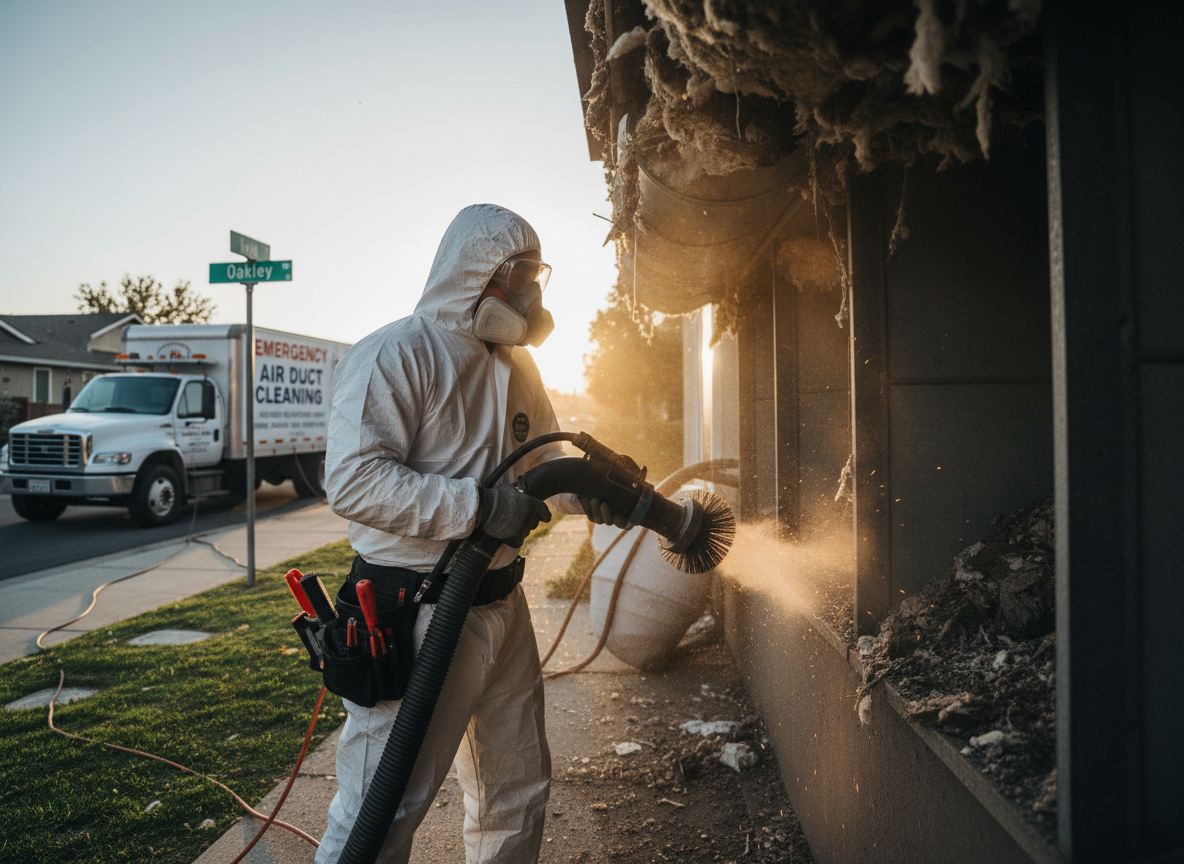
Oakley’s older brick homes and early-20th-century bungalows often have narrow, rigid metal ducts routed through tight joist bays and plaster walls. When a sudden event such as a kitchen fire, sewer backup, or heavy construction dust shuts down airflow, homeowners need crews who can reach those runs without tearing out ceilings. Emergency calls start with a camera inspection through existing registers to locate the blockage before any equipment enters the system.
Cincinnati’s spring pollen spikes and summer humidity combine to turn minor dust into thick, sticky buildup inside supply lines. In an emergency we isolate the affected trunk with temporary caps so the rest of the house stays usable while we work. Negative-air machines are set up on the exterior so exhaust does not re-enter through open windows common in Oakley’s dense street grid.
Access points in these homes are usually limited to basement trunks or attic returns. We carry extendable whips and reverse-air nozzles sized for the smaller-diameter pipes found in 1920s–1940s construction rather than assuming modern flex duct. Once the line is clear we restore airflow gradually to avoid blowing residual debris into living spaces.
After the immediate issue is resolved we document the remaining duct condition with photos so the homeowner can decide on a full cleaning later. All work is performed from the provided address at 2435 Williams Ave and dispatched 24/7 to reach Oakley within the hour when possible.
Technician insight
In Oakley the thing that catches most people out with Emergency Air Duct Cleaning is the narrow 4-inch and 5-inch rigid runs in 1920s–1940s bungalows that sit behind plaster and lath. Standard brushes won’t fit and forcing them damages the pipe, so we have to use extendable whips fed from the basement trunk instead.
Sudden Odor After Basement Water Event
A homeowner in Oakley noticed strong musty air coming from every supply vent after heavy rain flooded the crawl space. Camera inspection showed wet dust caked inside the main trunk feeding the first floor. We isolated that trunk, cleared the material with reverse-air tooling, and restored flow without opening walls.
How it works
- 1
Initial Assessment
Technician arrives, reviews the reported symptoms, and runs a camera through accessible registers to locate the obstruction.
- 2
Containment Setup
Negative-air machines and temporary seals isolate the affected section so dust does not spread to other rooms.
- 3
Targeted Clearing
Specialized whips and compressed-air tools break up and remove the blockage while monitoring airflow at each register.
- 4
Verification and Documentation
Final camera sweep confirms clearance; photos and notes are left for the homeowner’s records.
Pricing
Emergency service begins with a diagnostic visit; total cost varies with duct access difficulty and amount of material removed.