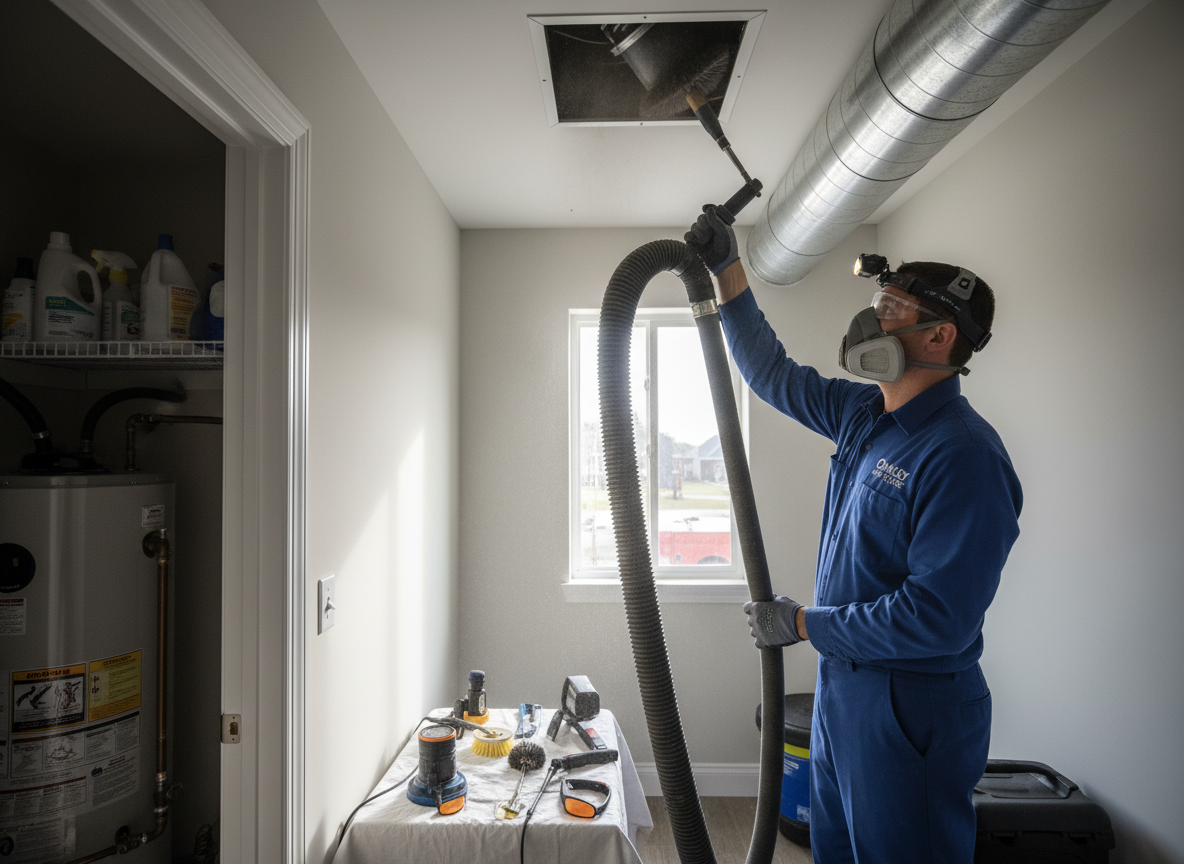
Oakley sits in Cincinnati's older housing stock where many homes built before 1950 still use original sheet metal ducts that run through basements and crawl spaces. These systems collect fine dust, insulation fibers, and pet dander over decades because the joints were never sealed to modern standards. Narrow returns near floor registers often trap the heaviest loads, especially after the humid Ohio summers pull moisture through the lines and cause minor corrosion at elbows.
Technicians must account for limited access points in these brick and frame houses. Removing registers without damaging plaster or hardwood floors requires careful planning, and negative-pressure equipment has to be positioned so it does not pull debris into finished living areas. In neighborhoods around Oakley, tree pollen and road dust from nearby Madison Road add to the load inside supply runs during spring and fall.
Edge cases include homes with partially collapsed flex duct sections added during past renovations and systems that share space with laundry vents. Forcing brushes through damaged lines can create new leaks, so visual inspection with a camera before any agitation step prevents callbacks. Homeowners sometimes attempt DIY vacuuming through registers and push material deeper into trunk lines, making professional extraction more time-consuming.
Technician insight
In Oakley, the thing that catches most people out with Residential Air Duct Cleaning is the original unlined ducts in pre-1950 homes that run right under the floor joists and collect decades of fine silt from the surrounding clay soil. Homeowners rarely notice until airflow drops in the upstairs bedrooms because the returns sit low and stay hidden behind furniture. We always start by checking those basement returns first.
Oakley Home with Restricted Upstairs Airflow
A homeowner in Oakley reported weak airflow on the second floor. Inspection showed heavy dust and insulation fibers packed into the main return trunk running under the first-floor joists. After camera mapping and negative-pressure cleaning of the rigid lines, airflow returned to normal without any new leaks introduced.
How it works
- 1
Initial Camera Inspection
Technicians map every accessible run from the furnace to the farthest registers, noting collapsed sections or heavy debris pockets common in Oakley basements.
- 2
Register and Vent Removal
Registers are taken out carefully to avoid marring original woodwork, then bagged to contain loose dust before any agitation begins.
- 3
Negative Pressure and Agitation
A vacuum unit creates continuous suction while brushes and compressed air dislodge material from the inside walls of the ducts.
- 4
Final System Check
All lines are re-inspected with the camera, registers reinstalled, and airflow tested at multiple points to confirm clear paths.
Pricing
Pricing varies by number of runs, access difficulty, and whether flex sections need replacement; site visit provides the exact scope before work starts.