Oakley homes often date to the 1920s through 1950s with original galvanized duct runs that run through plaster walls and low crawl spaces. These systems trap construction dust, pet dander, and insulation fibers that standard vacuum attachments cannot reach. Technicians from Orbit Wrench start at 2435 Williams Ave and bring sectional rods and forward-facing cameras to map every branch before any cleaning begins. Skipping the camera step leaves hidden elbows untouched and allows debris to recirculate after the first furnace cycle.
Summer humidity in the Oakley area combines with winter heating to create condensation inside metal ducts that sit against exterior walls. This moisture supports mold colonies on the duct seams, especially where the original tape has failed. Cleaning crews apply only EPA-registered sanitizers labeled for HVAC use and never fog entire systems, because overspray can reach living spaces through unsealed joints. Every register is removed and cleaned separately so no residue remains on floor surfaces.
Return-air pathways in Oakley bungalows frequently pull from basement corners where soil moisture migrates through limestone foundations. That fine silt travels into the ductwork and cakes on the blower motor. During service the motor and blower wheel are pulled and washed off-site when the home layout allows, preventing the fine grit from being redistributed on the next heat call. Homeowners are shown the removed debris so they can see why a single annual cleaning is rarely enough in these older structures.
Technician insight
In Oakley, the thing that catches most people out with air vent cleaning is the narrow joist bays in homes built before 1940 near the Oakley square; ducts were often squeezed between floor joists with almost no straight runs, so standard six-foot whips bind and leave the last three feet untouched unless you bring sectional rods.
Collapsed Flex in an Oakley Two-Story
Problem: homeowner noticed weak airflow from second-floor vents after a new roof installation. What we found: a crushed flex connector above the kitchen where roofers had stepped on the chase. What we did: replaced the crushed section, cleaned the remaining rigid runs, and sealed the new connection with mastic. Outcome: even airflow restored on every floor without opening finished ceilings.
How it works
- 1
Initial Camera Inspection
Technicians map every accessible run from the furnace to the farthest register using a forward-view camera to locate blockages and collapsed sections.
- 2
Register and Boot Removal
All floor and wall registers are taken out and cleaned individually so debris does not fall back into the cleaned ducts during the job.
- 3
Negative-Pressure Cleaning
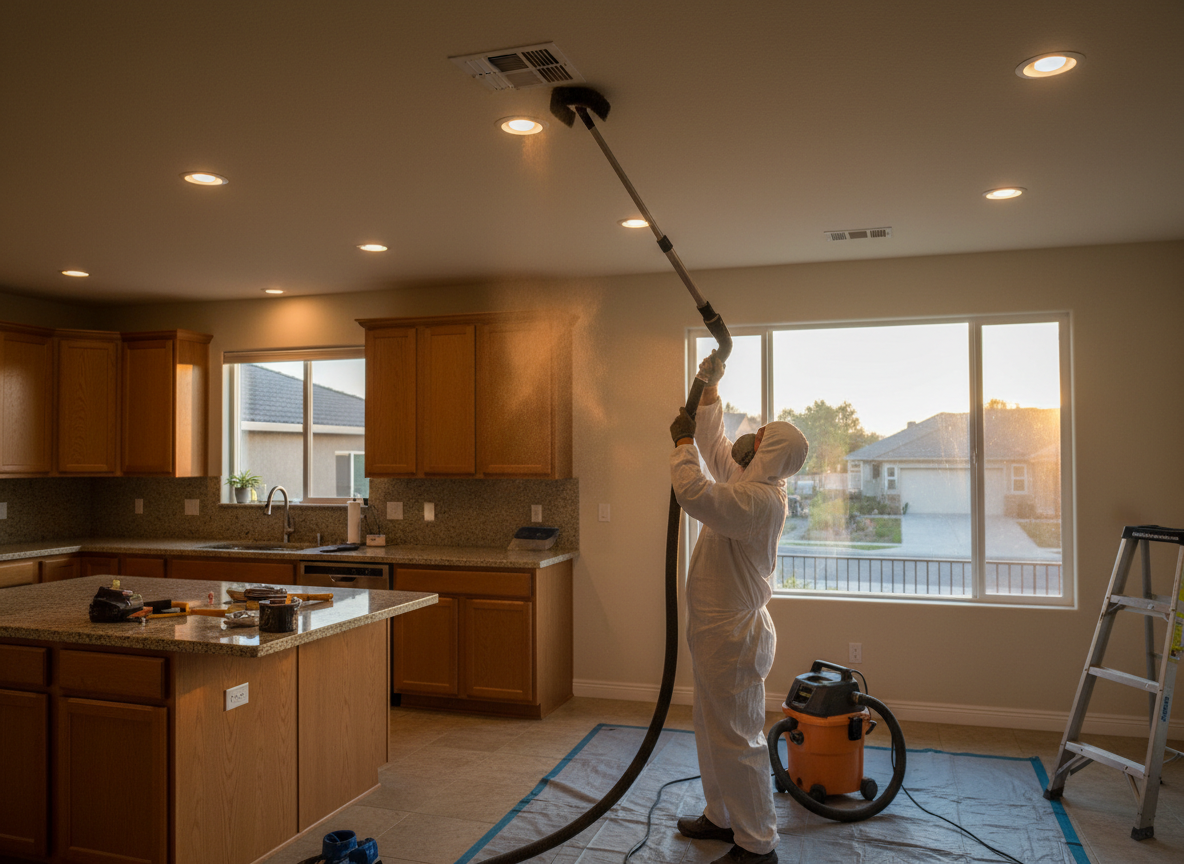
A HEPA-filtered vacuum is attached to the main trunk while brushes and whips agitate each branch, pulling loosened material directly into containment.
- 4
Final Walk-Through and Reassembly
Registers are reinstalled, airflow is checked at each vent, and the homeowner receives a video summary of the cleaned system.
Pricing
Cost depends on number of runs, access difficulty in older Oakley homes, and whether the blower assembly must be removed. Upfront quotes are given after the camera inspection.