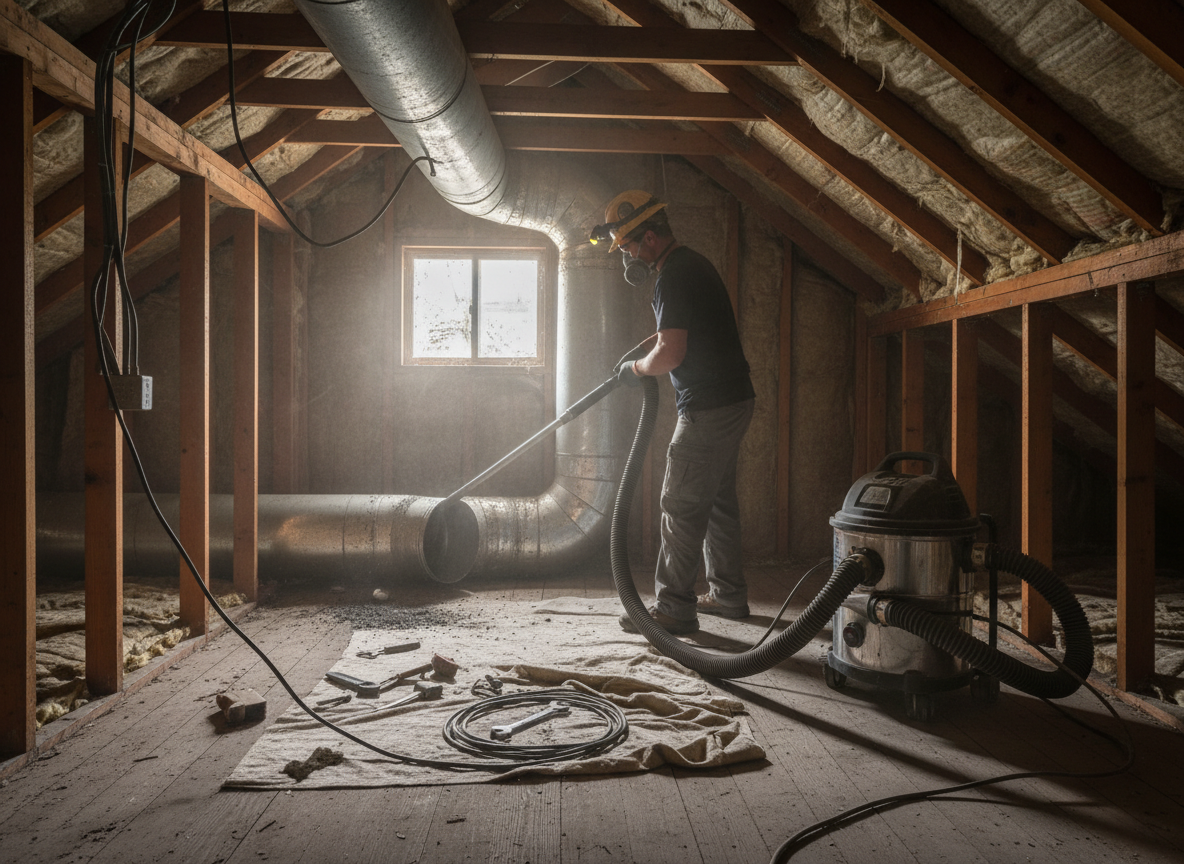
Oakley homes built before 1950 often route HVAC ducts through finished attics with shallow knee walls and blown-in cellulose. These setups trap fine dust against the duct exterior while internal buildup restricts airflow to second-floor rooms. Negative-pressure vacuuming from the register end combined with agitation tools is required to reach the bends near the ridge without disturbing insulation.
Summer humidity in the Cincinnati area drives condensation on metal ducts that lack exterior wrap. That moisture mixes with construction dust and creates a sticky layer that standard brushes miss. We use rotary whips sized for 6- to 8-inch round pipe and follow with a camera inspection to confirm the interior is clear before restoring insulation.
Access points in Oakley attics are frequently blocked by HVAC platforms or storage platforms added later. Removing sections of duct for cleaning is sometimes the only way to reach the main trunk near the gable end. We document every joint we open and reseal with mastic rather than tape so the system stays airtight after we leave.
Technician insight
In Oakley, the thing that catches most people out with attic duct cleaning is how pre-war homes have narrow scuttle holes right above the furnace platform, so you end up working around the unit and risk knocking insulation into the blower if you do not lay boards first.
Restricted Access in Oakley Attic
A homeowner in Oakley reported weak airflow upstairs. We found the main trunk partially blocked by settled cellulose near the gable vent. After clearing a path and vacuuming the line, we sealed two loose joints that had been pulling in attic air. Upstairs temperatures evened out the same day.
How it works
- 1
Attic Access and Safety Setup
We locate the pull-down or scuttle hole, lay down plywood walk boards, and protect insulation with drop cloths before any equipment enters the space.
- 2
Register and Duct Isolation
Supply and return registers are removed or sealed, then the system is isolated so negative pressure pulls debris only from the attic runs.
- 3
Agitation and Vacuum Extraction
Rotary brushes and compressed-air whips loosen material while a truck-mounted vacuum pulls it out through the nearest accessible end.
- 4
Joint Inspection and Sealing
Every accessible joint is checked with a camera; gaps are sealed with mastic and insulation is restored to original depth.
Pricing
Pricing depends on number of attic runs, access difficulty, and whether sections must be removed. Upfront quote after inspection.