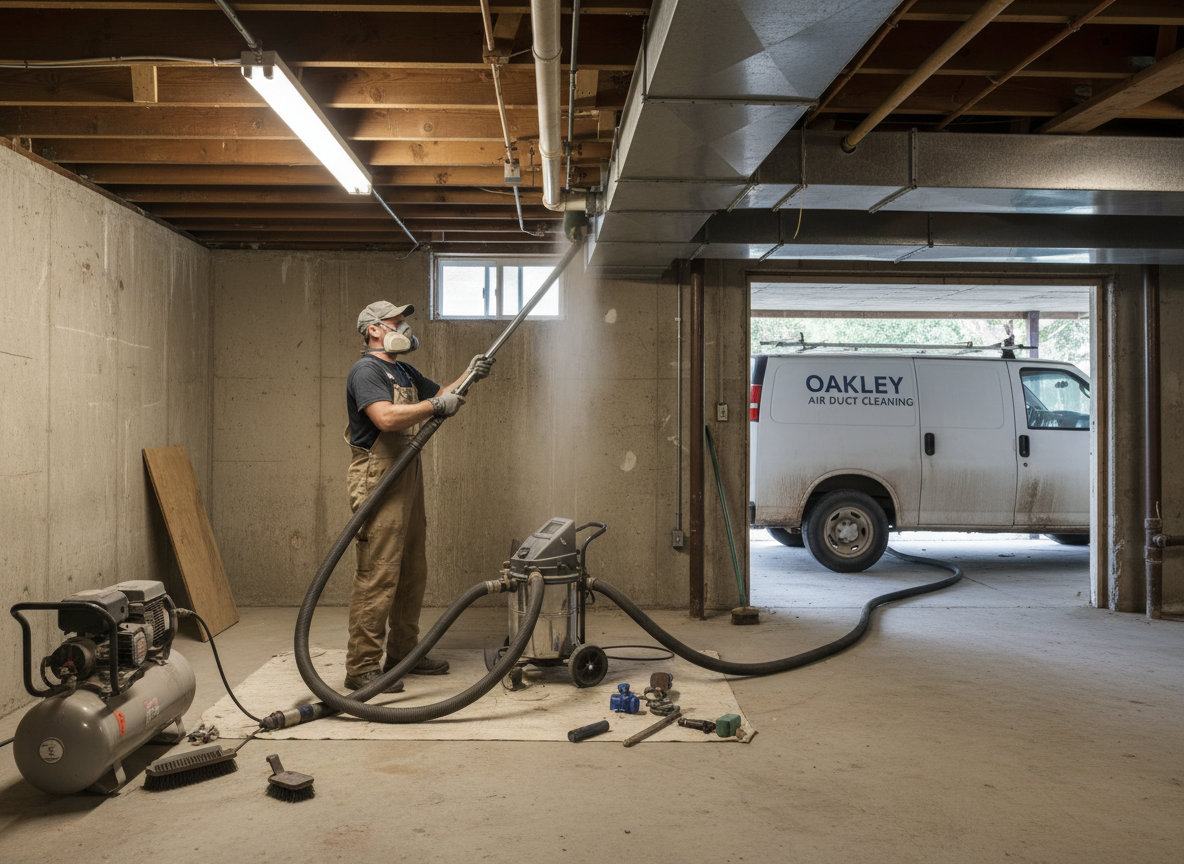
Oakley homes often feature early 1900s construction with basement ducts routed through stone foundations and low crawlspaces. These setups trap dust, insulation fibers, and seasonal pollen that standard whole-home cleaning misses. Basement-specific work requires separate negative-air machines and brushes sized for 4- to 6-inch branch lines to avoid damaging older sheet-metal seams.
High summer humidity in the Oakley area promotes condensation on uninsulated ducts, creating conditions for mildew growth along joints. Technicians must first check for active leaks or standing water before agitation begins. Skipping this step can push spores into living spaces above. Access panels are cut only where needed and sealed afterward to maintain system integrity.
Edge cases include homes near the Oakley rail line where vibration loosens duct connections over time. In these properties, crews secure joints before cleaning and test airflow afterward. Basement work also accounts for finished ceilings that limit visibility, requiring camera inspection first to map runs and locate blockages without unnecessary demolition.
After cleaning, registers are removed and washed separately because basement returns pull in more floor-level debris than upper-floor supplies. Final readings confirm static pressure returns to normal range, confirming no new restrictions were introduced during the process.
Technician insight
In Oakley, the thing that catches most people out with basement air duct cleaning is how many 1920s brick homes have uninsulated ducts running right above dirt floors. Moisture from the ground wicks into the metal and turns light dust into stubborn mud that clogs branches faster than in drier Cincinnati neighborhoods.
Oakley Basement Return Line Blockage
Homeowner noticed weak airflow from first-floor vents in an Oakley two-story. Inspection showed heavy debris in the basement return trunk where the duct sat inches above a damp floor. Crew isolated the section, ran brushes through the full length, and cleared packed material. Airflow returned to normal without disturbing the finished ceiling above.
How it works
- 1
Site Assessment
Technician inspects basement layout, measures duct runs, and checks for moisture or loose connections using a camera scope.
- 2
Containment Setup
Negative-air machines and floor protection are placed to isolate the basement from the rest of the Oakley home during agitation.
- 3
Mechanical Cleaning
Rotary brushes and compressed-air whips remove debris from main trunks and branch lines without damaging older metal seams.
- 4
Register and Final Check
Registers are cleaned separately, system is reassembled, and airflow is verified before leaving the property.
Pricing
Upfront quote based on duct length, access difficulty, and moisture conditions; no hidden fees.