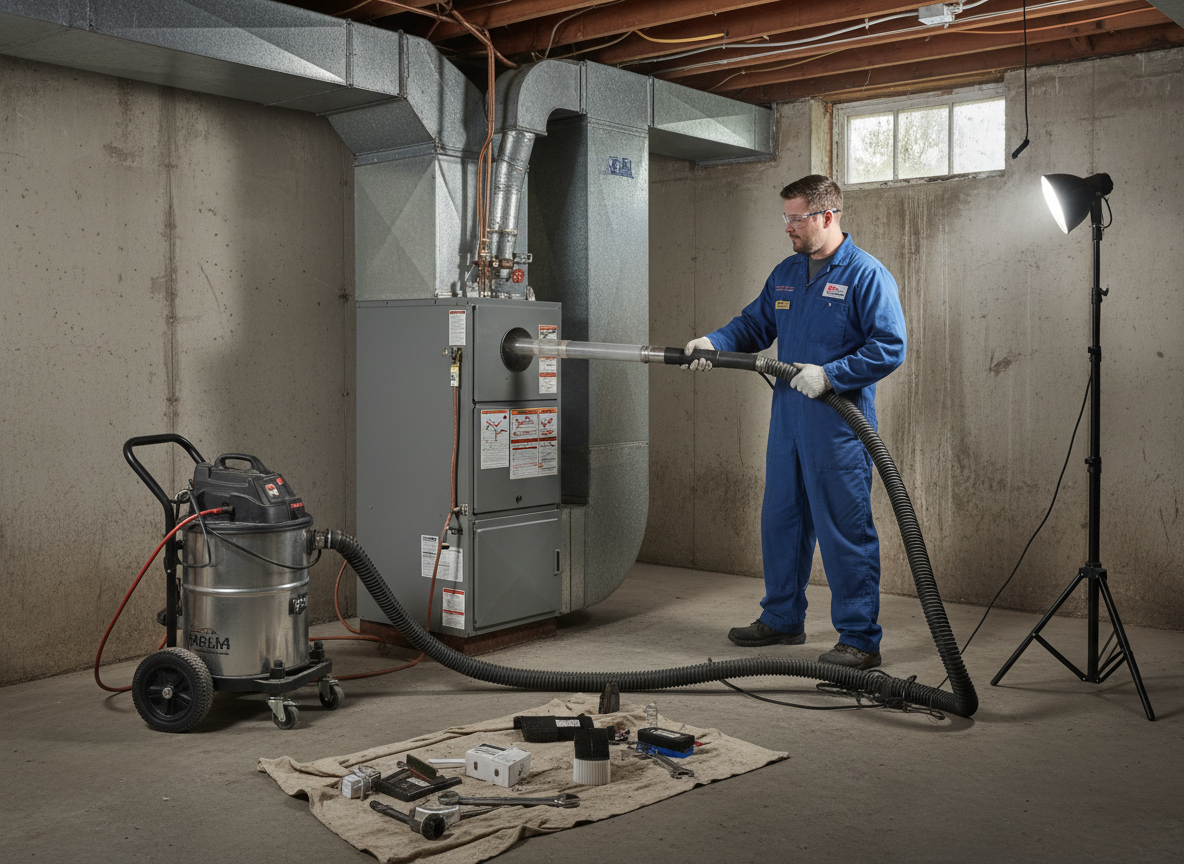
Oakley’s mix of early-1900s brick homes and mid-century builds means many furnace systems sit in tight basements or crawl spaces with limited access panels. When ducts run through unconditioned attics or along exterior walls, winter temperature swings pull dust and insulation fibers into the airstream. A proper cleaning starts with isolating the furnace, then using negative-air machines sized for the actual trunk line rather than generic shop vacs that can collapse flex duct.
In the Oakley area, high summer humidity followed by sudden cold snaps creates condensation inside metal ducts that rusts joints and feeds mold on any accumulated lint. Technicians must check for disconnected boots at registers, especially in additions where homeowners ran new returns without proper sealing. Skipping these spots leaves the system pulling unfiltered air from wall cavities once the furnace kicks on.
Before any equipment enters the home, the technician maps every supply and return, noting original galvanized pipe versus later flex runs. This prevents over-pressurizing sections that were never meant to handle full vacuum. After cleaning, a final camera sweep confirms no debris remains at elbows or transitions common in Oakley’s narrow floor joists.
Technician insight
In Oakley, the thing that catches most people out with furnace and duct cleaning is how many pre-war homes still have original galvanized runs that were never designed for modern high-velocity blowers. When you pull hard vacuum on those old elbows without checking the joints first, you create new leaks that pull dust from the joist bays. Always map the system before you start the machine.
Restricted Access in 1920s Oakley Bungalow
Homeowner reported weak airflow after installing a new filter. Inspection found the main return trunk running under a finished porch floor with no access panel. We cut a discreet entry point, extracted heavy lint and construction debris from the 1940s addition, then sealed the opening with a matching grille. Airflow returned to normal without disturbing the hardwood.
How it works
- 1
System Inspection and Mapping
Technician examines furnace, all accessible ducts, and register locations to identify access points and any disconnected sections before equipment setup.
- 2
Isolation and Containment
Furnace is isolated, supply and return openings sealed, and negative-air machine connected to capture debris without spreading it through the Oakley home.
- 3
Agitation and Extraction
Rotating brushes and compressed air dislodge buildup while the vacuum removes material from trunk lines, branches, and the furnace heat exchanger.
- 4
Final Verification and Reassembly
Camera inspection confirms cleanliness, seals are restored, and the system is returned to normal operation with any loose panels tightened.
Pricing
Upfront quotes provided after inspection; cost varies with number of runs, access difficulty, and whether flex or rigid duct is present.